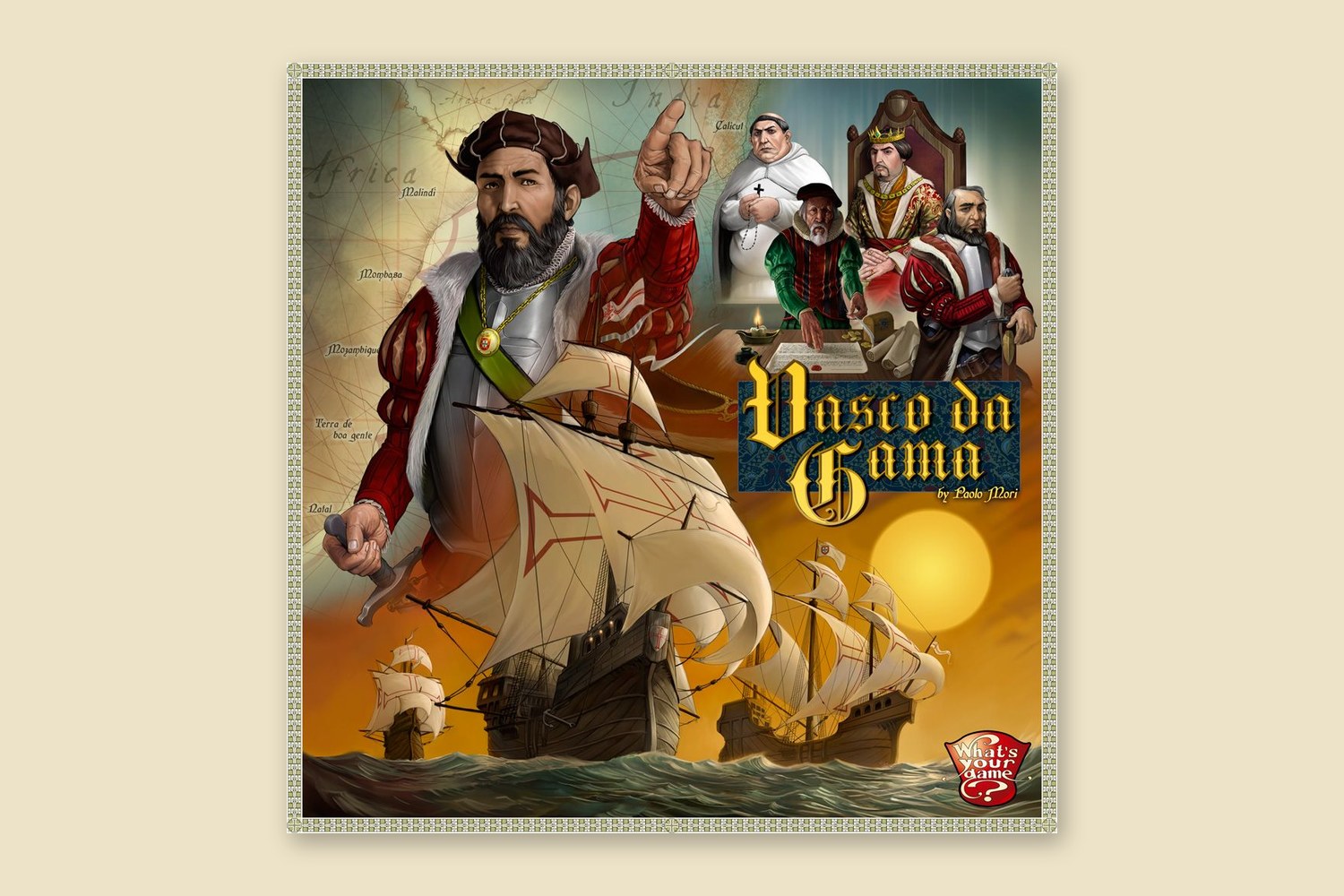
Vasco da Gama is a true classic: A 2009 Eurogame by Paolo Mori that transports us to the era of great Portuguese explorers. We hire crews, equip ships, and send them on long journeys to collect prestige points. It was published by What’s Your Game?, and even over a decade after its release, it still frequently appears on best-of lists for clever auction mechanisms. I wanted to know: How well has this game actually aged, and does it still hold its own alongside today's modern Eurogames?
Wertung
Lohnt sich Vasco da Gama?
Vasco da Gama bekommt von uns 7,5 von 10 Punkten. Das heißt bei uns: gut, es lohnt sich, das Spiel öfter zu spielen. Dafür spricht: Cleveres, einzigartiges Zeit-als-Gebot-System. Dagegen spricht: Knappes Finanzmanagement kann Einsteiger:innen überfordern. Spieleranzahl: 2–4.

Profile
- Players: 2–4
- Duration: 60–120 minutes
- Mechanism: Auction/Timing Worker Placement
- Theme: Age of Discovery / Trade Routes
The auction mechanism: Time is the scarcest resource
The heart of Vasco da Gama is an unusual auction system for your actions. Instead of bidding with money, you bid with time: each action has a time value, and whoever claims an action first pays less time for it than someone who enters later. At the end of the round, your spent time determines the turn order in the next round – those who traded quickly and efficiently can choose earlier, those who dawdled have to wait at the back and often only get the leftovers.
This principle creates a wonderful pull: on the one hand, you want to grab as many important actions as possible, but at the same time, you don't want to use up so much time that you fall completely behind in the next round. The right timing—when do I make a move, when do I deliberately leave an action to the other players—is the central strategic question of the entire game.
In addition, there is clever financial management: your cash is usually tight, and you have to calculate precisely how many sailors you hire, what ship equipment you can afford, and when an expensive investment really pays off. Those who spend their money too freely quickly run out of room to maneuver, while being too cautious lets valuable opportunities slip by.
From the quay to the big voyage: Equipping and dispatching ships
Before you can send out an expedition, you must first make your ships seaworthy: hire a crew, load provisions and equipment, and perhaps even bring high-ranking personalities on board who will grant you additional bonuses. Each of these preparations costs actions and resources, so you must carefully coordinate your entire round planning with when your ships are finally ready for the big voyage.
If your ships are equipped, you send them on journeys along the trade routes – past trading posts, exotic ports, and dangerous waters. Each successfully completed journey brings prestige points, with the exact route, your crew's equipment, and any acquired personality cards determining how profitable an expedition ultimately is.
Background: An auction game that was ahead of its time
Vasco da Gama was developed by the Italian author Paolo Mori and published in 2009 by the small but exquisite publisher What’s Your Game?. In an era when worker placement games were experiencing their major boom, Vasco da Gama stood out significantly from the crowd due to its unusual time-auction mechanism—a twist that has rarely been copied to this day, even though it has proven to be astonishingly elegant.
It's interesting how much the game hit the nerve of the time: it was released in the middle of the great era of Eurogame classics around 2008 to 2010, when titles like Le Havre or Agricola shaped the genre. Vasco da Gama never made as big a name for itself in this strong competition as the biggest hits of those years, but it is still considered a real insider tip among connoisseurs of the genre today, precisely because of its innovative core mechanism.
|
Häufige Fragen (FAQ) zu Vasco da Gama
Für wie viele Spieler ist Vasco da Gama geeignet?
Vasco da Gama ist für 2–4 Spieler ausgelegt.
Wie lange dauert eine Partie Vasco da Gama?
Eine Partie Vasco da Gama dauert 60–120 Minuten.
Welche Spielmechanismen nutzt Vasco da Gama?
Vasco da Gama setzt auf Auktion/Timing-Worker-Placement.
Wie bewertet Brettspiel Teddy Vasco da Gama?
Brettspiel Teddy bewertet Vasco da Gama mit 7.5/10 Punkten.
My conclusion
How well has Vasco da Gama aged? Surprisingly well, I must say. The time-as-a-bid mechanism still feels fresh and clever today because it creates a type of tension that many modern worker placement games just don't offer: you are competing not only for resources, but explicitly for turn order and pace. This creates constant decision-making pressure without making the game feel overloaded.
What I particularly like: Despite its age of over 15 years, Vasco da Gama doesn't feel dusty. The iconography is clear, the round progression is tight, and downtime remains pleasantly low thanks to the time system, because you're always planning the next round while others are still taking their turn. For fans of clever auction and timing mechanisms, this is still a real highlight that can easily compete with current new releases.
Anyone looking for Eurogames with historical flair and an unusual, yet deeply thoughtful core mechanism should definitely give Vasco da Gama a chance – whether as a rediscovery for experienced players or as a worthwhile first contact for anyone who has missed the title so far.
Pros & Cons
Pro
- Clever, unique time-as-a-bid system
- Low downtime thanks to constant forward planning
- Still surprisingly fresh even after more than 15 years
- Thematically fitting with a stringent implementation
Contra
- Tight financial management can overwhelm beginners
- Slightly dry presentation compared to modern titles
Advertisement: Buy Vasco da Gama – if you order through it, you support the channel at no extra cost to you:
Secure now
Leave a comment